Creatine is a molecule that is naturally produced in the human body. We also get it from our diet, specifically from meat. It is probably the most well-studied supplement in existence. As of 2026, researchers have published over 168 clinical trials involving more than 17,000 participants. To date, no studies have shown adverse side effects in healthy individuals.
If you only take one supplement, this should be it.
Creatine Quick Reference
What type to buy: Creatine monohydrate. Nothing else.
How much to take: 5g per day minimum. 10g per day if you weigh over 220 lbs.
One teaspoon of creatine is how many grams: One level teaspoon of creatine monohydrate weighs approximately 5 grams.
How much creatine is in a steak: A 2-pound (32 oz) steak contains roughly 5 grams of creatine. A typical 8 oz steak has about 1.25 grams.
When to take it: Whenever is most convenient. Timing does not matter much.
5g or 10g of creatine a day: 5g is enough for most people. Individuals over 220 lbs with significant muscle mass should consider 10g.
Is creatine safe: Yes. No adverse effects in healthy individuals. It is not a steroid and is not prohibited by WADA.
Do you need to load creatine: No. Loading is optional. Regular daily use of 5g will saturate your muscles within a few weeks.
Can you mix creatine with a protein shake: Yes. It does not dissolve well and may settle at the bottom, but it works fine.
What is Creatine?
All of your muscle contractions are powered by a molecule called adenosine triphosphate (ATP). In fact, ATP powers virtually every activity of every living cell on Earth. We’ll focus on its role in muscle contraction.
To put it simply, to contract your muscle requires energy. This energy is released from the ATP molecule by “breaking off” a phosphate group, leaving adenosine diphosphate (ADP) as a waste product. This ADP is recycled very quickly via the phosphagen system, which “mashes” phosphocreatine (PCr) together with ADP to produce new ATP. This energy system burns hot and fast, like a jet afterburner, and runs out of fuel quickly due to a rather limited amount of naturally occurring PCr in our cells.
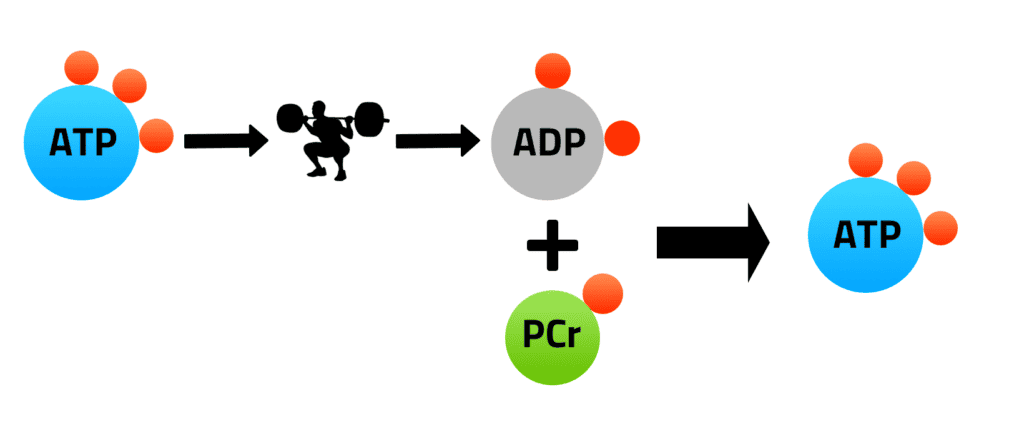 Illustration of the phosphocreatine energy system
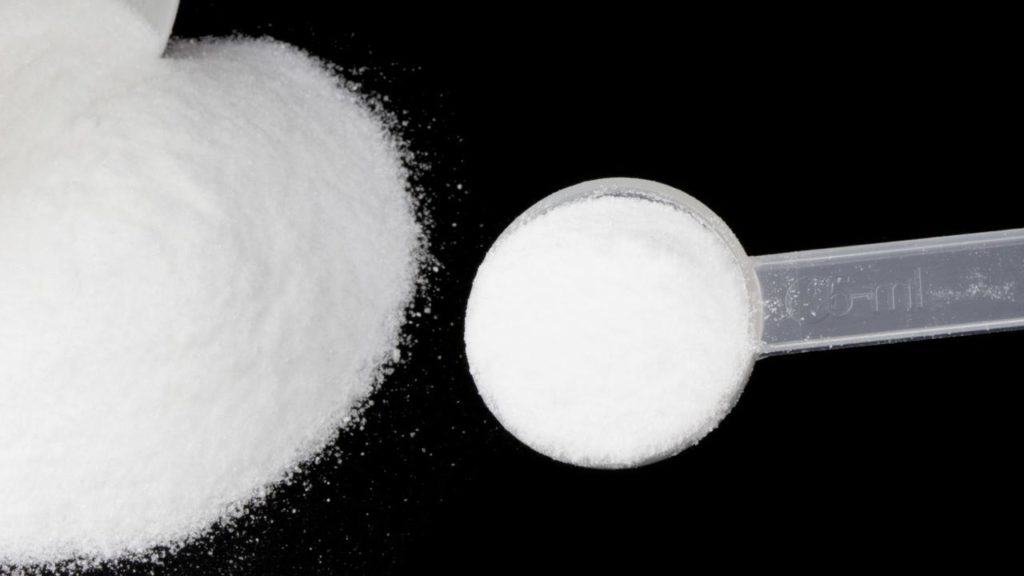
You can eat a lot of meat and only increase your PCr levels a little bit. A 2-pound steak has about 5 grams of creatine in it. Five grams of the supplement form of creatine fit in a teaspoon. Supplementing with creatine allows us to significantly increase the creatine levels in our cells without eating large quantities of meat.
What does this mean for your performance? The ATP-PCr system primarily powers short bursts of intense work lasting about 10 seconds or less. Supplementing makes you stronger and faster. Where you might have failed your 2nd or 3rd rep of squats, you can instead get 5 reps.
What Does the Research Actually Show?
Creatine is backed by a staggering amount of evidence. Here are the findings with the strongest support, based on Examine.com’s review of the literature:
Strong evidence (Grade A):
- Increases muscle creatine content (large increase)
- Improves strength (moderate improvement, 49 studies)
- Improves power output (large improvement)
- Reduces exercise-induced oxidative stress (moderate decrease)
Good evidence (Grade B):
- Increases muscle mass (small improvement)
- Decreases body fat (small decrease)
- Improves muscular endurance (small improvement)
- Reduces muscle damage from training (small decrease)
- Improves memory (16 studies, 492 participants)
- Improves symptoms of sleep deprivation (small improvement)
- Reduces depression symptoms (moderate improvement)
- Increases total body water and hydration
That last section might surprise you. The cognitive and mental health benefits of creatine are relatively new findings in the research, and they are worth paying attention to. Your brain is one of the most metabolically active organs in your body. It uses ATP like everything else, and creatine supplementation appears to help there too. The memory and sleep deprivation data in particular are backed by multiple studies with hundreds of participants.
When to Take Creatine
Some studies indicate that creatine supplementation might have slightly greater effects when taken closer to resistance training workouts compared to other times of the day. Current data does not show a meaningful difference between taking it pre-workout, post-workout, or both.
I advocate just taking it whenever it is most convenient for you. Consistency matters. Timing does not.
How to Take Creatine
There are two approaches: loading and not loading.
Loading means taking a higher dose for the first week to saturate your muscles faster. The protocol used in most research is about 0.3 grams per kilogram of bodyweight per day for 5 to 7 days, divided into four doses spread throughout the day. For a 180 lb (82 kg) person, that is roughly 25g per day. After the loading phase, you drop to a maintenance dose of 3 to 5g per day.
It’s important that you do not take the loading dose all at once. Take it with meals and plenty of water. High doses at once can cause stomach cramping, nausea, and diarrhea.
Not loading means just taking 3 to 5g per day from the start. Your muscles will fully saturate within 3 to 4 weeks. You end up at the same place, it just takes longer to get there.
I have never loaded. I’ve taken 10g a day for over a decade. Most people will do fine with 5g per day. Individuals over 220 lbs with significant muscle mass and high activity levels should consider 10g.
You can mix it in with your protein shake. It doesn’t dissolve very well so it may make it a little gritty and settle at the bottom. This bothers some people. An alternative I use is to just dump my dose directly on my tongue and down it with a swig of water. Creatine monohydrate is odorless and tasteless.
What to Buy
You can spend a lot of money on well-marketed creatine products. Please don’t. The most effective and cheapest form to buy is creatine monohydrate. Many manufacturers offer other variations such as creatine nitrate, creatine ethyl ester, and creatine citrate. Avoid them all. None are as effective as creatine monohydrate. All of the research we mentioned? It’s been done on creatine monohydrate.
One variation worth noting is micronized creatine monohydrate. Micronizing is just additional processing that makes the particles finer. This doesn’t affect its absorption rate in your body, but it makes it easier to mix with water since regular creatine monohydrate is not very soluble and mostly just suspends itself in water temporarily.
Want expert coaching on your strength training? Chicago Strength & Conditioning offers online coaching for lifters anywhere in the world. You get individualized programming, video feedback on your lifts, and ongoing adjustments from a Certified Starting Strength Coach. Creatine helps, but good coaching helps more. Get in touch to learn more.
Frequently Asked Questions
Q: Is creatine safe?A: Yes. Research involving over 17,000 participants has found that side effects do not differ from a placebo in healthy individuals. Gastrointestinal discomfort is the most commonly reported issue, and it tends to happen more during loading and in older populations. If you have pre-existing kidney disease or are taking nephrotoxic medications, consult your doctor first.
Q: Is creatine a steroid or performance-enhancing drug?
A: No. It’s food. Your body makes it naturally and you get it from meat. It is not prohibited by the World Anti-Doping Agency (WADA) as of 2026. A few prominent baseball players in the late 90s took anabolic steroids and then credited creatine for their massive physical growth and strength, which caused a lot of confusion that persists to this day.
Q: Is it safe to take it year round? Should I cycle it?
A: Yes, it is safe to take continuously. There is no need for cycling.
Q: Does creatine cause hair loss?
A: This concern comes from a single study that showed an increase in DHT (a hormone linked to hair loss) in college-age rugby players during a creatine loading protocol. No other study has replicated this finding, and no studies have directly measured hair loss from creatine supplementation. The evidence does not support this concern.
Q: Is creatine safe for your kidneys?
A: In people with healthy kidneys, creatine supplementation does not cause kidney damage. Creatine does increase creatinine levels (a waste product that doctors use as a marker for kidney function), which can make blood tests look abnormal if your doctor doesn’t know you supplement. Let your doctor know you take creatine so they can interpret your lab work correctly. If you have pre-existing kidney disease, talk to your doctor before supplementing.
Q: Does creatine help with anything besides strength?
A: Yes. Recent research shows moderate evidence for cognitive benefits including improved memory, reduced impact of sleep deprivation, and reduced symptoms of depression. Your brain uses a lot of ATP, and creatine appears to support brain energy metabolism in a similar way to how it supports muscle function. These findings are relatively new and the research is still growing.
Q: How much creatine is in a steak?
A: Raw beef contains roughly 2.5 grams of creatine per pound. A typical 8 oz steak has about 1.25 grams. A large 2-pound steak has about 5 grams, which is the same as one teaspoon of creatine monohydrate powder. You would need to eat a lot of meat to match what a single teaspoon of the supplement provides.
Q: How many grams of creatine are in a teaspoon?
A: One level teaspoon of creatine monohydrate powder weighs approximately 5 grams. This is the standard daily dose for most people.
Q: Should I take 5g or 10g of creatine a day?
A: 5g per day is sufficient for most people. If you weigh over 220 lbs, have significant muscle mass, and train frequently, 10g per day is reasonable. There is no benefit to taking more than 10g.
Q: How many grams of creatine are in a tablespoon?
A: A level tablespoon of creatine monohydrate is approximately 15 grams, or about three times the standard daily dose. Most people should use a teaspoon (5g), not a tablespoon.
Q: Can you put creatine in a protein shake?
A: Yes. Creatine monohydrate is odorless and nearly tasteless. It does not dissolve well, so it may make the shake slightly gritty or settle at the bottom. This does not affect how it works.
References
- Examine.com. Creatine: Scientific Review on Usage, Dosage, Side Effects. Last updated January 5, 2026. 167 references, 17,248 participants across 168 trials and 19 meta-analyses.
- Rippetoe, Mark. Starting Strength: Basic Barbell Training, 3rd Edition.
Disclaimer
The author of this guide is not a certified dietician or nutritionist and makes no claims to the contrary. Each individual's dietary needs and restrictions are unique to the individual. Information is provided to the best of our ability. You are ultimately responsible for all decisions pertaining to your health.This guide is written and produced for informational purposes only. Statements within this guide have not been evaluated or approved by the Food and Drug Administration. This guide is not designed to and does not provide medical advice, professional diagnosis, opinion, treatment or services to you or to any other individual. This guide is not intended to diagnose, treat, cure, or prevent any disease. The information provided in this guide, or through links to other resources, is not a substitute for medical or professional care, and you should not use the information without the advice of your physician or another healthcare provider.