My daughter lost an arm-wrestling contest to a boy at school when she was 11. She decided that was unacceptable. Two years later, training twice a week, she holds eight national powerlifting records.
I didn’t know any of that on the day she walked up to me, in April of 2024, and asked, “Dad, can you teach me to lift?”
I almost didn’t believe her. I figured it was a setup. She was 11, barely interested in anything that wasn’t dance, orchestra, or hanging out with her friends. Lifting weights wasn’t on the list. The arm-wrestling part I didn’t find out for two more years. At the time, I just knew she was serious and that she wanted to get stronger.
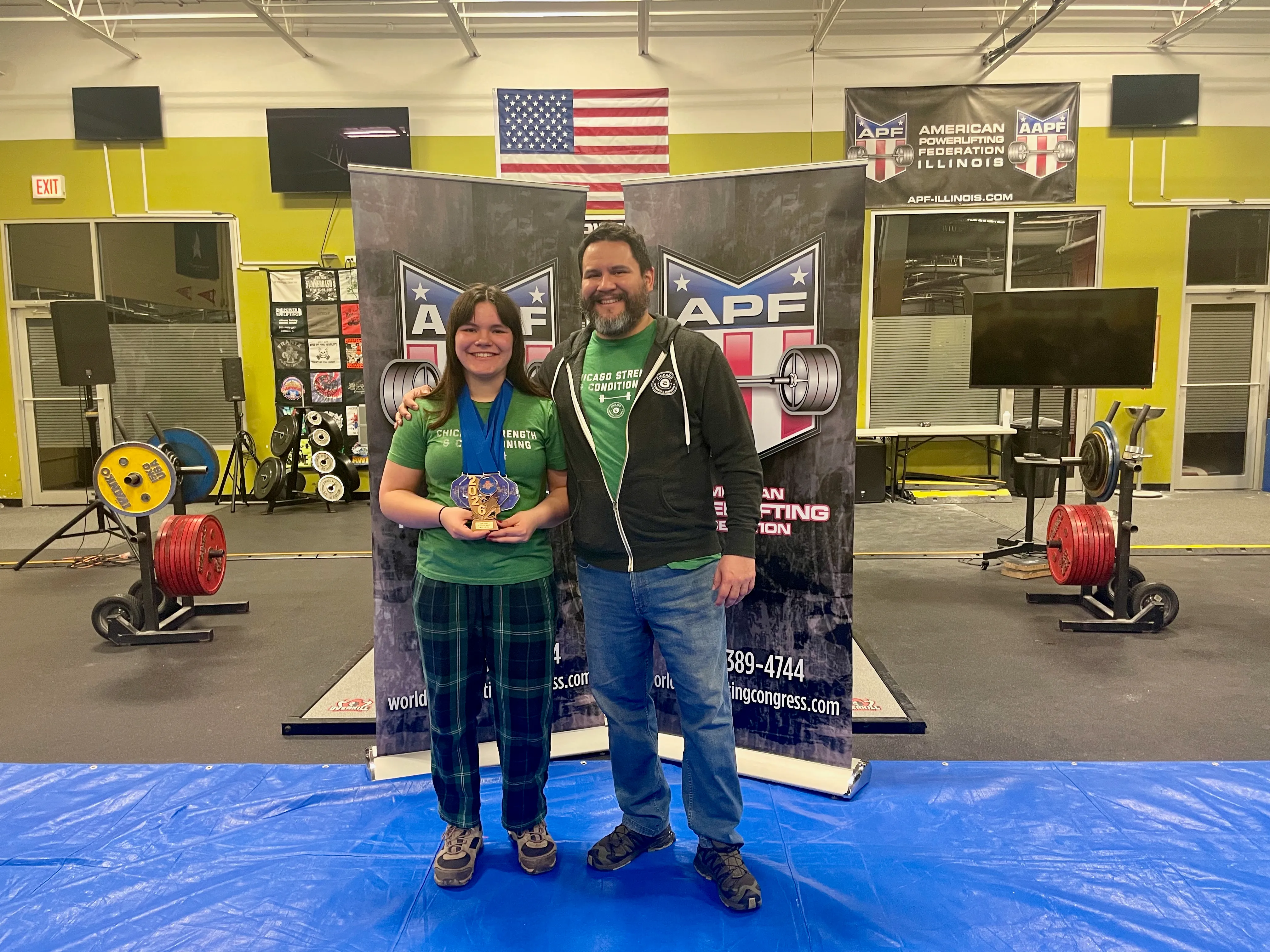
Audrey now holds eight national records in the APF and AAPF. She’s the first woman at Chicago Strength & Conditioning to earn The Sticker (a 100 lb press, 155 lb bench, 225 lb squat, 315 lb deadlift). At her most recent meet, the 2026 Illinois State, she won Best Lifter Teen and placed third in the Women’s Open division at age 13.
I wrote up the full case study, with all the programming details, for Starting Strength: Two Years, Two Days a Week: Coaching a Female Novice to National Records. If you want the technical version, with the weights, the resets, the Texas Method block leading into her third meet, that’s where it lives.
This isn’t that article. This is what I learned coaching my own kid.
I Almost Made It Too Hard
When Audrey asked me to teach her, my first instinct as a coach was to run her through a real Novice Linear Progression. Three days a week, push until she fails, reset, push again. That’s how it’s supposed to work.
But she wasn’t going to do that. Three days a week wasn’t going to happen. She had dance, orchestra, school, and a perfectly reasonable interest in not spending half her free life in a gym with her dad. So we trained twice a week. That was the deal.
The bigger thing I had to talk myself out of was the urge to push hard early. I had low expectations about whether this would last past eight weeks. Kids change their minds. So I did something that goes against most of my coaching instincts: I prioritized comfort. I added small, conservative jumps to the bar. I let the toughness sneak up on her instead of front-loading it. I wanted to see if she had grit before I asked her to spend any.
That decision is the reason any of the rest of it happened. If I’d made her first month feel like a punishment, she would have quit, and that would have been the end of it. The slow, enjoyable start bought me the next two years.
A Kid’s Enjoyment Is a Programming Variable
Most coaching writing treats programming as a math problem. Stress, recovery, adaptation, intensity, volume. All true. But with a young athlete, there’s another variable that’s just as real: do they want to come back next week?
I think a lot of parents make their kids hate sports by treating their enjoyment as a nice-to-have instead of as the actual thing keeping the program alive. I’ve watched it happen. The kid is good at something, the parent gets invested, the kid stops being able to tell where their own want ends and their parent’s want begins. By the time they’re 14 or 15, they quit and never look back.
I tried very hard not to do that. When Audrey came back from a two-week sleep-away camp in 2024, I made her train the same day she got home. She gave me the loudest sigh and the largest eye roll I’d ever seen. That was the only time in two years I forced her into the gym, and I did it because I knew if I let her skip that day, the next day would be easier to skip, and the day after that easier still. One firm nudge from me, then back to letting her drive.
Past that, the rule was: she’s the lifter, I’m the coach. I program. She trains. If she’s not having fun, we figure out why. If she’s tired or sore, we adjust. The grit she’d later show on a 70 kg bench press wasn’t something I drilled into her. It’s something she found because nobody was making her hate the bar.
The Moment She Decided She Was a Lifter
At her second meet, in December 2025, she made her bench press second attempt at 62.5 kg. Comfortable, fast, looked like she had more in the tank.
I asked her: “65 or 67.5?”
She said: “70.”
I raised my eyebrows, walked over to the scoring table, and turned in 70 kg. Internally, I gave her about a 50% chance. Nothing in her training said this was a sound choice. The biggest bench she’d done in the gym was 62, and that was a stretch.
Out loud, I didn’t say any of that. As the women on either side of her started missing their third attempts, I told her this:
“You’re going to see a lot of misses now. The third attempt of women’s bench is always like this. Watch how they fail. Almost all of them quit fast. A second of effort and they give up. What you’re about to do is going to be hard. Not impossible. Hard. If you only try for a second, you won’t get it. You’re going to need to put everything into this. All that matters is you don’t quit. Just drive your heels and push and push. Make them take the bar from you.”
She got it. It took her about eight seconds to lock out. Her back cramped halfway up. She kept pushing. That was the moment she stopped being a kid who lifted and started being a lifter.
That’s not a thing I taught her. That’s a thing she found in herself, with a barbell on her chest, because she’d put in two years of consistent work and had earned the right to be in that situation.
What This Means If You’re a Parent
A few things I want parents to know.
When it’s done correctly, with a coach who knows what they’re doing, a barbell is one of the safest pieces of equipment a young athlete can use. The load is controlled. The movements are slow and deliberate. The progression is small and measured. Audrey had two minor training disruptions in two years, a tailbone issue from a heavy deadlift and a brief hamstring twinge, and both resolved within days.
Strength also carries. It carries into every other sport, every other activity, every other physical thing she’ll do for the rest of her life. Audrey is a better athlete in dance, in PE, in just walking through the world, because her body works. That doesn’t go away when she stops competing.
It does something for them that’s hard to name.
The closest word is grit. The looser version is confidence. The most accurate version is that she now knows, in her body, that hard things are doable if you don’t quit. You can’t lecture that into a kid. You can only put them in situations where they have to find it, and a barbell is one of the cleanest situations there is. The weight either goes up or it doesn’t.
What you actually need to make any of this work is a coach who has done it before. The vast majority of “youth strength training” content online is written by people who have never coached a young athlete through a real linear progression. Most commercial gyms aren’t set up for it either. Find a Starting Strength Coach. The credential exists for exactly this reason: to certify that the person teaching you the lifts actually knows how.
If you’re a parent in Chicago and your kid is interested in getting stronger, I’d love to help. We’ve coached teens here from age 12 up. The lifts are the same. The methodology is the same. We just adjust the programming to fit a kid’s life and a kid’s recovery.
What This Means If You’re An Adult Who’s Busy
The other thing this case study quietly proves, that I want to make loud: training twice a week works.
A common reason adults give for not starting is time. “I can’t commit to three or four days a week.” “I’m too busy.” “I’d start if I had more time.”
Audrey trained twice a week for two solid years and set eight national records. She was 11 when she started. She had school, dance, orchestra, friends, sleep-away camp, and the full attentional bandwidth of a sixth grader. If she can build a national-record squat on two days a week, your job, your kids, and your commute aren’t the obstacle you think they are.
You don’t need optimal. You need consistent. Show up twice a week, lift with a coach who knows what they’re doing, add a small amount of weight every session, and don’t quit. That’s the whole game.
What Happens Next
In two weeks, Audrey is competing at APF/AAPF Teen Nationals in Ogden, Utah, on May 7. The meet also runs under the international WPC/AWPC umbrella, which means on top of her existing national records, she’ll be competing for world records.
Past that, she’s going to keep training. Her squat is 150 kg at 13 years old, training twice a week most weeks, and the program is still working. There’s a lot of road left.
I’ll keep coaching her. I’ll keep telling parents that yes, your kid can do this, and yes, it’s worth it.
If you want to see what real coaching looks like, for your kid or for yourself, book an Intro Barbell Clinic. Two hours, one-on-one, no experience required. We’ll teach you the lifts, find your starting weights, and from there we’ll build something that lasts.